
Search & Discoverability
SEO foundations that help your content, pages, and offers get found by the right audience.
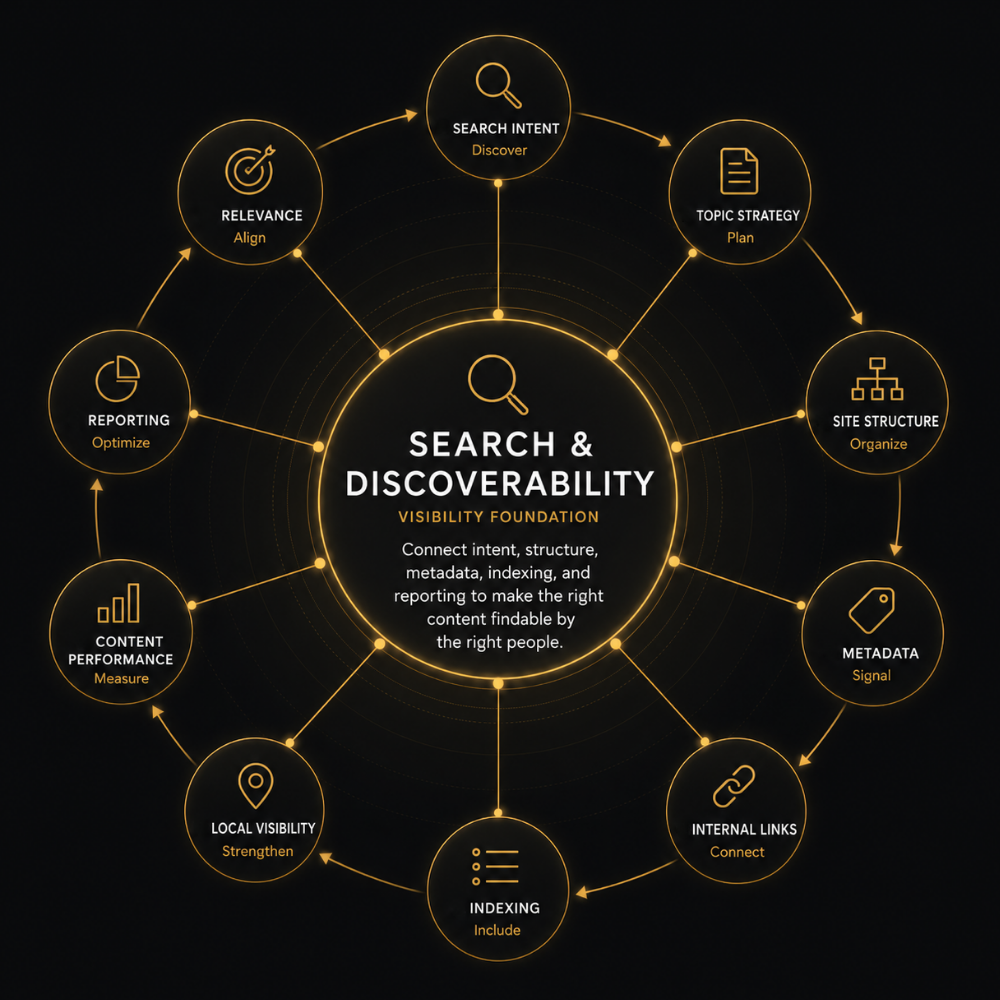
DOES improves the discoverability layer of your lifecycle marketing system, connecting search intent, content structure, technical SEO, internal linking, metadata, and performance review into one visibility framework.
Search Visibility Built Into the System
Search should not sit apart from your content, website, or conversion strategy. It should help the right audience discover your business, understand your expertise, and move toward a meaningful next step.
DOES builds search and discoverability foundations that support content-led acquisition, conversion infrastructure, lead capture, reporting, and long-term growth.
Structure
Clean site architecture, internal linking, headings, metadata, and schema foundations that help search engines understand your content.
Intent
Keyword and topic strategy aligned with what your audience is actually searching for, not just broad traffic opportunities.
Technical Health
Speed, mobile usability, indexing, crawlability, and technical cleanup that support stronger search performance.

Relevance
On-page optimization that connects content, keywords, supporting pages, and user intent into a clearer experience.
Visibility
Sitemap, robots.txt, metadata, local signals, and indexing support that help important pages become easier to discover.
Measurement
Search Console, GA4, ranking review, content performance, and visibility reporting used to guide ongoing improvement.
The goal is not just more rankings. The goal is a visibility system that connects customer intent to the pages, resources, and offers that move your business forward.
How Search & Discoverability Works
Search visibility is not created by keywords alone. It depends on how your website is structured, how your content answers customer intent, how pages connect to each other, and how clearly search engines can crawl, index, and understand your site.
When search and content work together, your website becomes easier to find, easier to navigate, and easier to connect to the next step in the customer journey.
DOES builds search and discoverability systems with the larger lifecycle journey in mind, so visibility supports acquisition, conversion, lead capture, email follow-up, and long-term customer value.
Search & Discoverability FAQs
Frequently asked questions about search strategy, technical SEO foundations, content visibility, indexing, local discoverability, and performance review.
Search and discoverability is the foundation that helps your content, pages, and offers get found by the right audience.
It includes keyword and topic strategy, site structure, metadata, internal linking, indexing, technical SEO, local visibility, and performance review. The goal is to make your website easier for both search engines and potential customers to understand.
Traditional SEO often focuses heavily on rankings, keywords, and technical checklists. Those things matter, but search and discoverability looks at the larger system.
DOES connects SEO to your content, website structure, lead capture, email follow-up, CRM, and reporting, so visibility supports the full customer journey instead of existing as a standalone service.
Yes. Keyword and topic strategy are part of the search and discoverability process.
DOES reviews search intent, customer questions, business priorities, competitive opportunities, and existing content gaps to help determine what pages and resources should be created, optimized, or improved.
Yes. DOES can review and improve an existing SEO setup when the foundation is usable.
This may include page optimization, metadata, internal linking, site structure, technical cleanup, content improvements, indexing support, local visibility, analytics, and performance reporting.
Search results depend on competition, site history, content quality, technical health, publishing consistency, and how much authority already exists.
Some technical or on-page improvements can create quicker gains, but meaningful organic growth usually builds over time. The goal is to create a search foundation that compounds instead of chasing short-term ranking movement.
Yes. Search can support lead generation when it is connected to the right content, offers, forms, and follow-up paths.
Traffic alone is not enough. DOES helps connect search visibility to pages, lead magnets, calls to action, email capture, CRM segmentation, and reporting, so discoverability can support measurable acquisition.
Yes. Technical SEO can be part of the search and discoverability work.
This may include site speed, mobile usability, crawlability, indexing, metadata, redirects, sitemap and robots.txt review, schema foundations, internal linking, page structure, and other technical elements that affect visibility and usability.
Yes. DOES can support local search visibility when it is relevant to the business.
This may include local landing pages, service-area content, Google Business Profile alignment, metadata, internal linking, location-specific content, and content strategies that help connect local search intent to your website.
DOES does not focus on low-quality link building, spammy outreach, or shortcut-based backlink tactics.
The preferred approach is to build stronger content, better site structure, useful resources, and owned marketing assets that can support long-term authority. If backlink strategy is needed, it should be handled carefully and aligned with quality, relevance, and brand trust.
Search performance can be measured through impressions, clicks, rankings, organic traffic, indexed pages, engagement, conversions, form submissions, lead capture, and content performance.
DOES looks at how search contributes to the larger lifecycle system, not just whether a keyword moved up or down. The goal is to understand which pages and topics attract the right audience and support measurable business outcomes.
Build a Search Foundation That Supports Long-Term Growth
If your content is hard to find, poorly structured, or disconnected from the rest of your marketing system, DOES can help turn search visibility into a stronger acquisition layer.